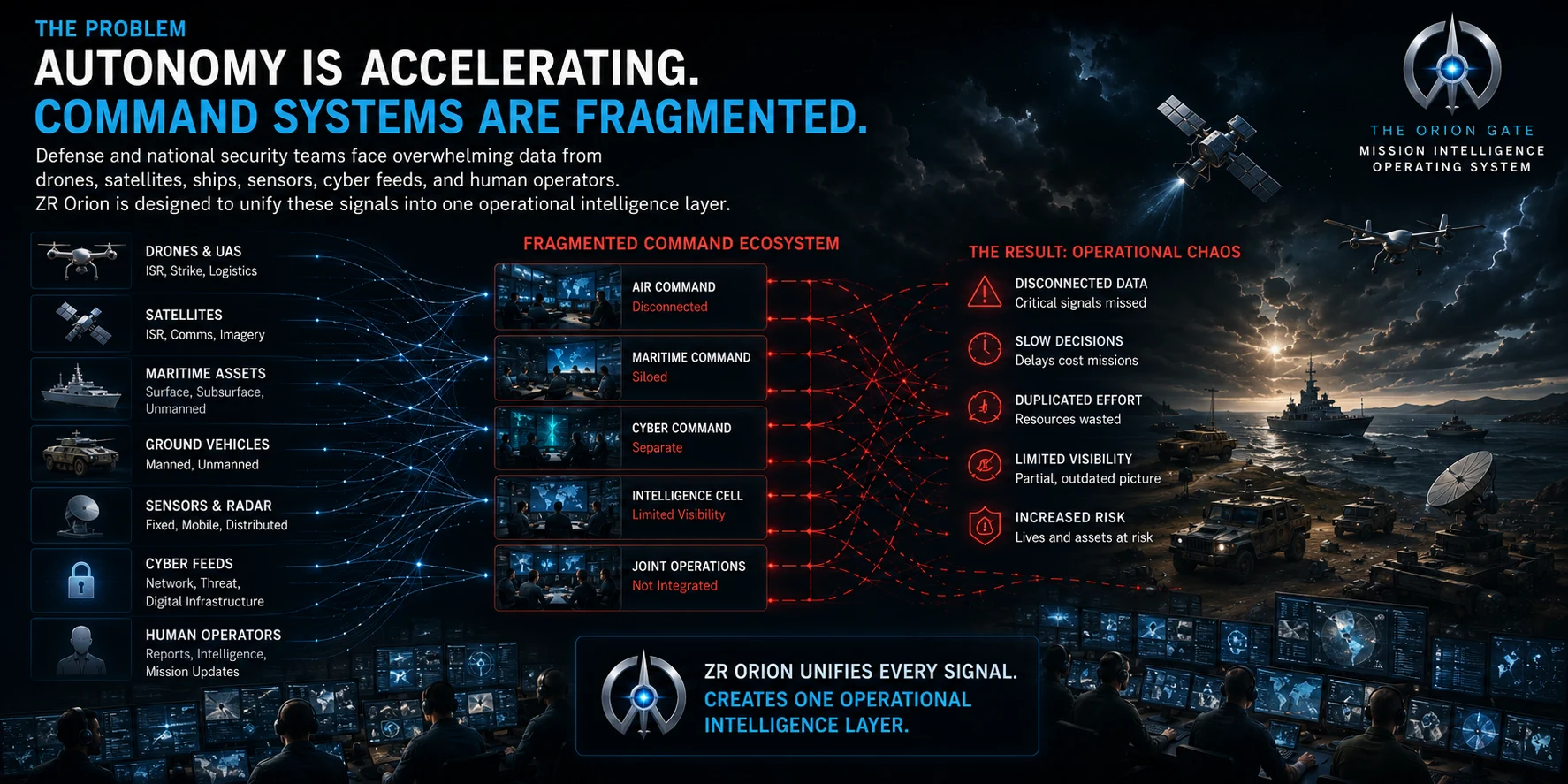
Autonomy is accelerating. Command systems are fragmented.
Defense and national security teams face overwhelming data from drones, satellites, ships, sensors, cyber feeds, and human operators. ZR Orion is designed to unify these signals into one operational intelligence layer.
Fragmented Sensors
Drone video, satellite imagery, maritime signals, infrastructure alerts, and ground sensors need one truth layer.
Decision Overload
Operators need clear recommendations, context, and mission options rather than more disconnected dashboards.
Autonomy at Scale
Future missions will involve thousands of autonomous assets coordinated through human-approved workflows.
Operational Challenge
Autonomous systems, sensors, satellites, cyber feeds, and human operators are expanding faster than traditional command systems can coordinate them. This creates fragmentation at exactly the moment mission environments require speed, precision, and trust.
ZR Orion frames this as a command architecture problem. The future will not be defined by platforms alone, but by the intelligence layer that connects them.
Why Existing Systems Fail
Most systems were built around individual platforms, not cross-domain coordination.
Operational Consequences
Fragmented command increases delay, uncertainty, and cognitive load.
Why It Matters
Mission success increasingly depends on coordinated intelligence, not raw data volume.