Command™
Mission orchestration across the complete lifecycle
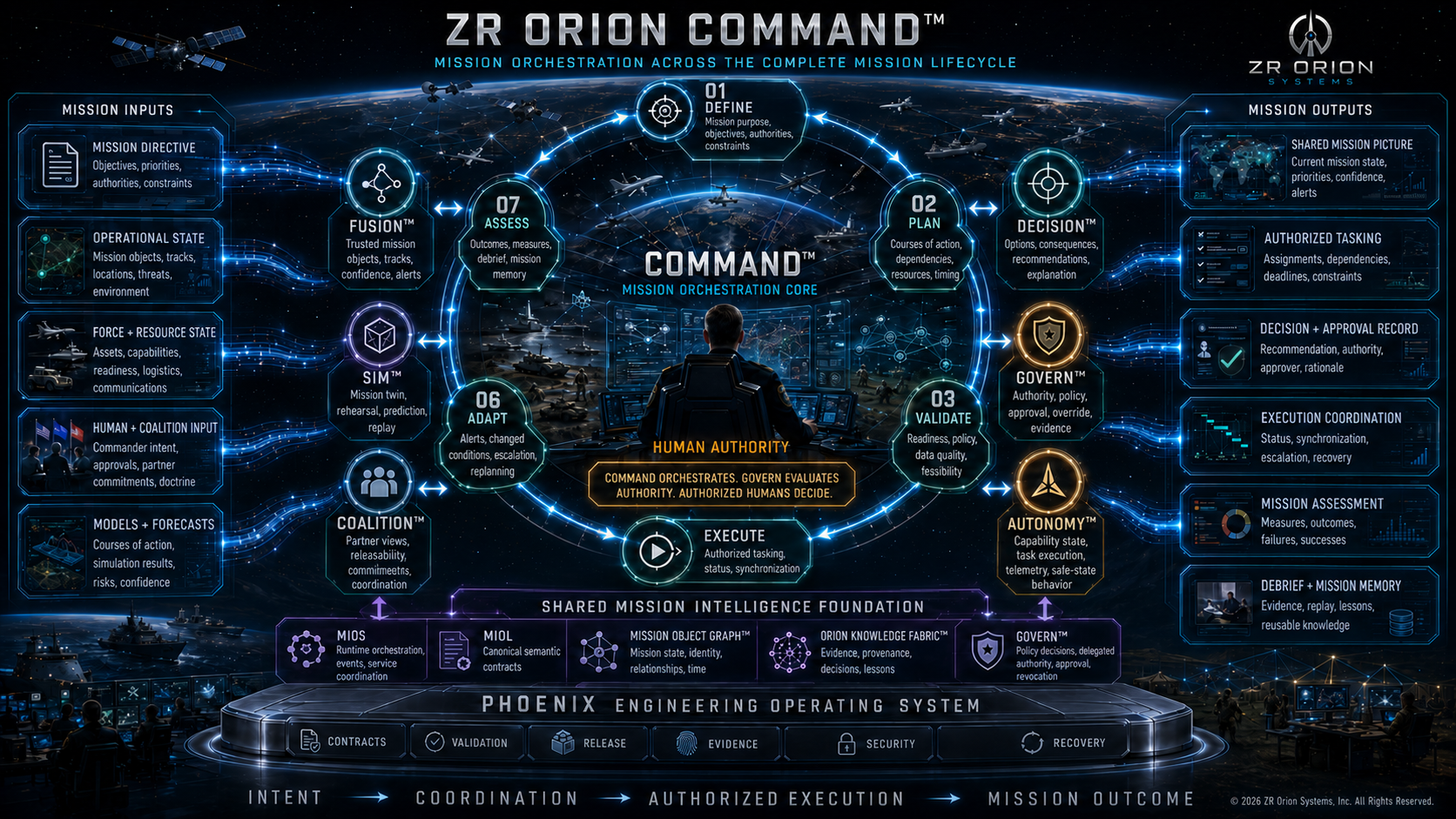
Converts authorized mission intent and human decisions into coordinated plans, tasking, execution state, contingencies, assessment, and mission memory.
Mission coordination gap
Intent, dependencies, authority, resources, execution state, and outcomes are often fragmented across documents and systems.
Command™
Converts authorized mission intent and human decisions into coordinated plans, tasking, execution state, contingencies, assessment, and mission memory.
A bounded lifecycle with explicit evidence at every transition.
What this capability does, and what it never becomes.
Owns
Converts authorized mission intent and human decisions into coordinated plans, tasking, execution state, contingencies, assessment, and mission memory.
References
Shared mission context, policy, evidence, product contracts, human decisions, and platform services remain governed by their authoritative owners.
Never Does
Command orchestrates; Govern authorizes; Decision recommends; humans decide.
Independent responsibility. Governed exchange.
The product collaborates through versioned mission objects, events, commands, queries, snapshots, authority decisions, and evidence. It does not silently absorb another product’s responsibility or infer authority from technical access.