Sim™
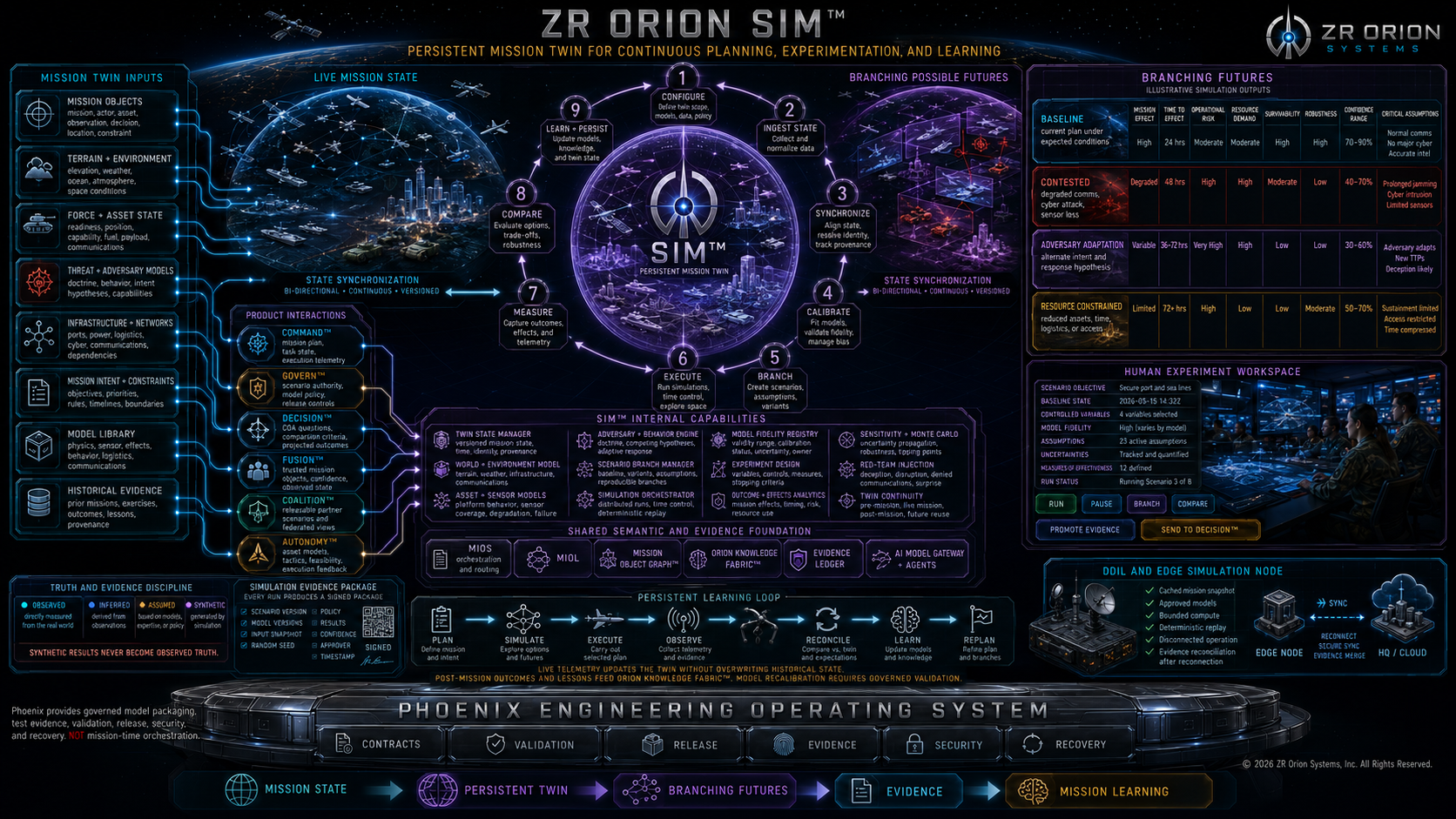
Persistent mission twin and possible futures
Creates versioned possible futures from governed mission state while preserving the boundary between observed truth and synthetic results.
Experimentation gap
Live operations are unsafe for experimentation, while hidden models and assumptions create irreproducible forecasts.
Sim™
Creates versioned possible futures from governed mission state while preserving the boundary between observed truth and synthetic results.
A bounded lifecycle with explicit evidence at every transition.
What this capability does, and what it never becomes.
Owns
Creates versioned possible futures from governed mission state while preserving the boundary between observed truth and synthetic results.
References
Shared mission context, policy, evidence, product contracts, human decisions, and platform services remain governed by their authoritative owners.
Never Does
Synthetic outcomes are evidence about modeled futures, never direct observations of the world.
Independent responsibility. Governed exchange.
The product collaborates through versioned mission objects, events, commands, queries, snapshots, authority decisions, and evidence. It does not silently absorb another product’s responsibility or infer authority from technical access.