Fusion™
Trusted mission objects from multi-domain observations
Converts heterogeneous observations into governed, evidence-backed mission-object assertions with uncertainty, provenance, policy, and human adjudication preserved.
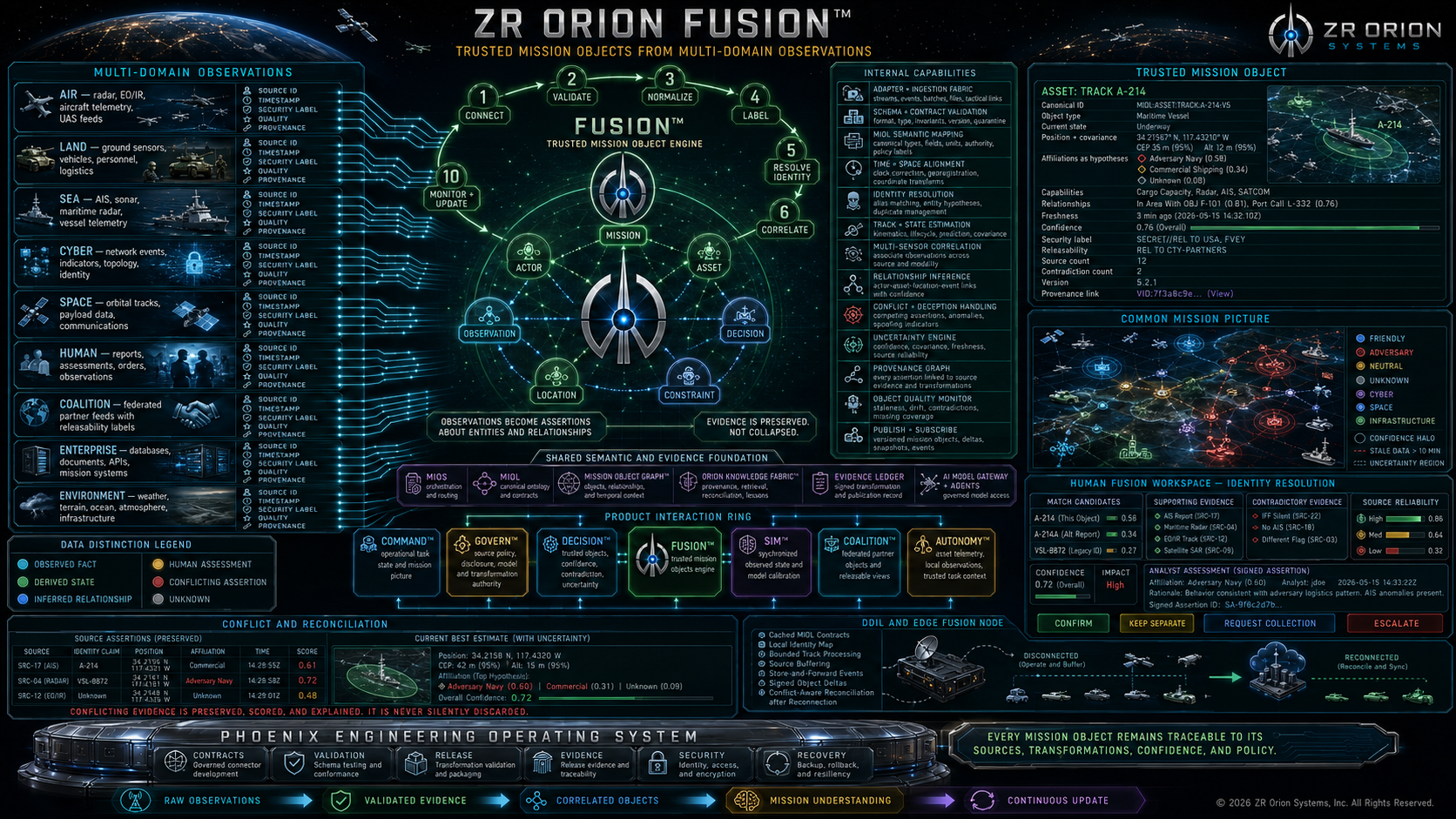
Fusion gap
Different schemas, late data, conflicting observations, ambiguous identity, and variable source quality can manufacture false certainty.
Fusion™
Converts heterogeneous observations into governed, evidence-backed mission-object assertions with uncertainty, provenance, policy, and human adjudication preserved.
A bounded lifecycle with explicit evidence at every transition.
What this capability does, and what it never becomes.
Owns
Converts heterogeneous observations into governed, evidence-backed mission-object assertions with uncertainty, provenance, policy, and human adjudication preserved.
References
Shared mission context, policy, evidence, product contracts, human decisions, and platform services remain governed by their authoritative owners.
Never Does
Fusion increases understanding without granting authority, choosing actions, or discarding contradictory evidence.
Independent responsibility. Governed exchange.
The product collaborates through versioned mission objects, events, commands, queries, snapshots, authority decisions, and evidence. It does not silently absorb another product’s responsibility or infer authority from technical access.